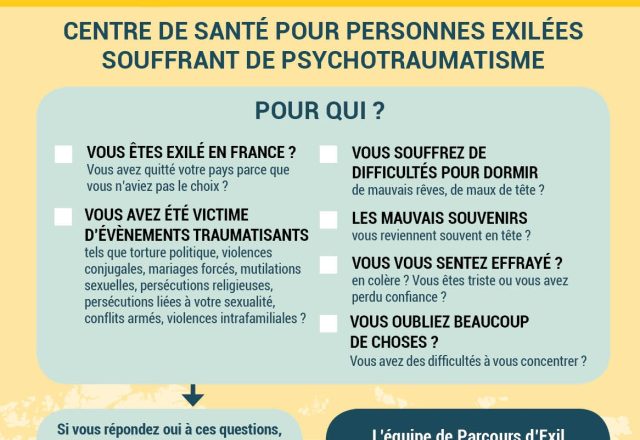
Le centre de santé Parcours d’Exil offre à toute personne exilée souffrant de psychotraumatisme des soins gratuits et inconditionnels grâce à son équipe pluridisciplinaire.
Parcours d’Exil, centre de formation de référence certifié Qualiopi, propose des formations sur le psychotraumatisme, l’exil et la prévention des risques psychosociaux.
Parcours d’Exil propose des séances de supervision d’équipe et des groupes d’analyse des pratiques professionnelles pour accompagner professionnels et bénévoles œuvrant auprès des migrants.
S’engager auprès de Parcours d’Exil peut prendre des formes multiples : bénévolat, dons ou salariat. Ce soutien permet aux personnes exilées victimes de persécutions de retrouver dignité, autonomie, confiance en eux et dans les autres.
Depuis 20 ans, Parcours d’Exil a développé son expertise au sein de son centre de soins basé à Paris, en collaborant notamment avec l’ensemble des acteurs de terrain (associations, acteurs de santé) et les acteurs institutionnels. Parcours d’Exil y a développé une approche thérapeutique unique en France, avec une prise en charge globale, physique et psychologique, des personnes migrantes par un médecin généraliste et une équipe pluridisciplinaire composée de psychologues et ostéopathes. Cette approche utilise des thérapies (TTC, EMDR, etc.) recommandées par l’Organisation Mondiale de la Santé et s’appuie sur les compétences interculturelles de nos thérapeutes.
L’exil est un évènement de vie difficile et stressant qui se caractérise par un déracinement et par de nombreuses pertes telles que perte de statut, d’identité, de relations sociales voire familiales ou de conditions matérielles. Certains migrants ont également vécu des situations particulièrement traumatisantes (torture, guerres, persécutions religieuses, violences conjugales ou familiales) qui viennent altérer leur santé psychique de façon durable. On parle alors d’état de stress post-traumatique ou psychotraumatisme.
On désigne par psychotraumatisme l’ensemble des symptômes physiques et psychiques qui se développent chez un individu ayant assisté à un évènement traumatique, c’est-à-dire un évènement où son intégrité physique ou psychique (ou d’un de ses proches) a été menacée.
Le récit traumatique… celui qui nous effraie, nous laisse sans voix et comme intérieurement figés, sidérés. Celui dont on aimerait qu’il s’arrête. Celui qui paradoxalement...
Le dispositif national de soutien aux professionnels revient avec une offre étayée: Une équipe de trois psychologues Des webinaires de formation Une newsletter trimestrielle Et...
Parcours d’Exil met à la disposition de toutes personnes accompagnant des personnes en exil, souhaitant nous les référer, cette présentation du parcours de soin. Cette...
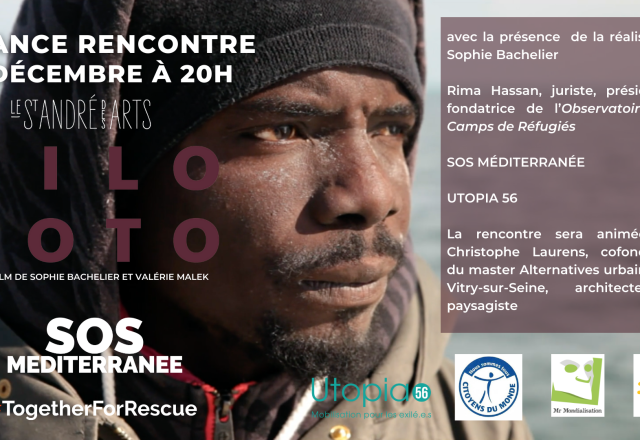
Parcours d’Exil soutien l’organisation de la séance rencontre au Cinéma Saint-André des Arts le 17 décembre 2022 TILO KOTO (67 minutes) suit le parcours du Casamançais Yancouba Badji....
Toujours soucieuse d’enrichir sa pratique, l’association Parcours d’Exil offre à son équipe de thérapeutes une formation certifiante à la thérapie EFT. L’EFT, pour Emotional Freedom...